More than a Meal
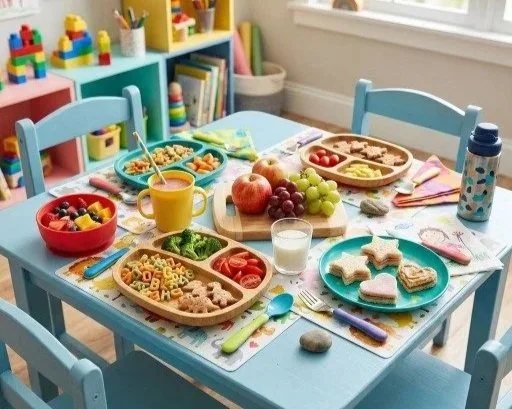
Feeding Toddler Development with Intentional Mealtimes
Young children spend a significant portion of their day while in childcare engaged in self-help skills (a.k.a. Adaptive Skills), especially mealtime routines. Children in full-day center care/family-based care typically have breakfast, lunch, and afternoon snack. Some may even have a mid-morning or late afternoon snack depending on arrival/departure times. To keep a steady energy level for toddlers, meals and snacks are provided every two-three hours.
That adds up to approximately 60-120 minutes per day engaged in a vital learning activity.
Mealtimes and snack times can sometimes be mistaken for merely a break in other learning and play activities. There is research to show, however, that mealtimes have the potential to be essential learning activities for young children based on their growth along a developmental continuum.
“In a child care setting, mealtime routines become the key to increasing a toddler’s independence and growing individuation.”
In the first three years, children move along this continuum from homeostasis as an infant to attachment (2-6 months) to individuation, according to Rhonda Mattingly (2018) in her online article Typical Feeding Development: An Overview.
In the first few months of life, the safety and stability of a parent or other adult builds regulation for an infant. If the first two stages are well established, individuation will then occur for a toddler between 6 and 36 months. Children then begin to see themselves individuals and separate from adults.
They want to organize their body and actions for themselves. They want to have control over what they eat.
A parent or familiar adult’s role no longer controls how a toddler eats. Instead, their role provides structure and routine to support the desire for independence.
In a childcare setting, mealtime routines become the key to increasing a toddler’s independence and growing individuation.
Between 6-9 months and extending to 36 months toddlers are entering into and developing a new independent sense of self. This begins with accepting purees from an adult, finger feeding, emerging use of a spoon, accepting an open cup, holding and sipping from an open cup, independently managing utensils, requesting what they would like to eat or refusing, and experimenting with a variety of foods.
As toddlers progress in their motor and adaptive skills, they can begin to socially integrate with peers as part of a meal/snack time routine. This is where the importance of adult-led routines comes in.
Progress from individuation to social integration as described in the abstract by Kalhoffe, et al. (2024), Development of Eating Skills in Infants and Toddlers from a Neuropediatric Perspective, offers tremendous learning opportunities to build the later developmental skills- personal responsibility(adaptive), social-emotional growth, and cognitive (problem-solving) skills.
What types of developmental skills can mealtime routines build?
Adaptive Skills
● Fine and gross motor skills
● Oral motor skills leading to speech development
● Independence
● Confidence
● Responsibility for self (hygiene, clean-up, communicating wants and needs)
Social-Emotional Skills
● Social interaction
● Managing frustration
Cognitive Skills
● Problem-solving skills that encompass the preceding adaptive and social-emotional skills and evolve to include planning and sequencing for an entire meal
I will shine a light on these skills in the next blog, so watch for a follow-up.
To transform mealtimes from simple nutritional breaks into robust learning opportunities, caregivers must intentionally design the environment and the experience. By adhering to a framework that prioritizes consistency, social connection, and developmental milestones, we can ensure that every snack and meal serves as a foundation for growth.
Thinking of Five essential pillars of an effective mealtime routine, early childhood educators can ensure it is:
Routines-based
The routines before, during and after a meal/snack are consistent. The preparation and clean-up are consistent as well.Socially Engaging
Adults join toddlers for meals and snacks. They become a meal partner not just a server.Developmentally Appropriate
Caregivers present developmentally appropriate foods and proper sized table/chairs, utensils, cups, plates, serving spoons.Skill Building Expectations
When toddlers are given the opportunity to be active participants in snack/mealtimes they are able to build their confidence, independence and responsibility for self.Low Pressure Experience
Meals should be enjoyable and not hurried. Meals and snacks are an important part of the day and an experience in and of themselves.
Together, these elements create fundamental opportunities where toddlers feel confident to explore, interact, and master new adaptive and cognitive skills.
References:
Eat Play Love OT. (n.d.). Understanding feeding milestones for infants and toddlers: Insights from a pediatric occupational therapist.
https://www.eatplayloveot.com/infant-to-toddler-feeding-development-milestones
Kalhoff, H., Kersting, M., Sinningen, K., & Lücke, T. (2024, June 3). Development of eating skills in infants and toddlers from a neuropediatric perspective. Italian Journal of Pediatrics, 50(1), Article 110. https://pubmed.ncbi.nlm.nih.gov/38831369/
Mattingly, R. (2018, May 1). Typical feeding development: An overview. https://www.occupationaltherapy.com/articles/typical-feeding-development-an-overview-4325